Walk through any major car market in Lagos—Ladipo, Mushin, or Ikorodu—and you will see them. Vehicles that look brand new, with gleaming paint and spotless interiors, selling for prices that seem almost too good to be true.
Many of these cars started their journey as crumpled metal at Copart or IAAI auctions in the United States.
The trade in accidented (salvage) vehicles from the US to Nigeria is not a small niche. It is a multi-billion dollar industry. Between 2023 and 2025 alone, Nigerians spent N4.31 trillion on passenger car imports, with a significant portion sourced from the United States . A substantial percentage of these vehicles arrived with accident histories, were repaired in Nigeria, and now ply Nigerian roads as “tokunbo” vehicles.
Why has this trade flourished? The economics are compelling. An accidented vehicle purchased for $3,000 at auction, shipped to Lagos for $1,500, repaired for ₦500,000, and cleared with lower customs duties can yield significant savings compared to buying a clean-title vehicle.
But importing accidented cars is not without risk. Hidden structural damage, flood-damaged electrical systems from hurricane states, and improperly repaired vehicles cost many Nigerians millions in unexpected repairs.
This guide provides a comprehensive roadmap for importing accidented cars from the US to Nigeria. You will learn which damage types are repairable and which to avoid, how to calculate your total landed cost including duty advantages, step-by-step repair and clearance processes, and how to protect yourself from the most common traps—especially flood-damaged vehicles from Florida, Louisiana, and Texas .
By the conclusion of this guide, you will be equipped to import accidented vehicles profitably and safely.
What Are “Accidented” Cars? Understanding US Title Types
In Nigerian parlance, “accidented” cars refer to vehicles that have sustained damage and been written off by insurance companies in developed countries. In the United States, these vehicles receive specific title brands that indicate their history .
US Title Types Explained
| Title Type | Meaning | Suitability for Nigerian Import |
|---|---|---|
| Clean Title | No major damage history; never written off | High — but more expensive |
| Salvage Title | Insurance company declared vehicle a total loss after accident, theft, or flood | Suitable — most common accidented import |
| Rebuilt Title | Salvage vehicle repaired and recertified in the US | Suitable with caution |
| Flood Title | Water damage (electrical system compromised) | AVOID — electrical problems plague Nigerian roads |
| Bill of Sale Only | No title document available | DO NOT IMPORT — cannot be registered in Nigeria |
| Junk/Non-Repairable | Vehicle not roadworthy, for parts only | DO NOT IMPORT — cannot be legally driven |
Critical note: Some US states (Oklahoma, Kentucky, Texas, Georgia) re-issue titles without the salvage brand for export vehicles. This practice can make a salvage vehicle appear to have a clean title. Only a VIN history report from a NMVTIS-approved provider will reveal the original brand .
Why Insurance Companies Write Off Vehicles
In the United States, a vehicle is declared a “total loss” when the cost of repair exceeds a certain percentage of the vehicle’s value—typically 75% to 100%. This threshold varies by state and insurance company.
However, labor costs in the US are substantially higher than in Nigeria. A repair that costs $8,000 in the US might cost only ₦500,000 (approximately $330) in Nigeria. This discrepancy creates the arbitrage opportunity that Nigerian importers exploit .
As one dealer explained: “Over there abroad, the cost of salvaged or accidented vehicles is very cheap compared to the cost of new vehicles. They abandon or label a vehicle accidented once the door, boot, or windscreen is damaged. The engine will still be working perfectly” .
Why Accidented Cars Are Popular in Nigeria
Economic Advantages
The primary driver of the accidented car trade is affordability .
| Vehicle Type | Approximate Cost (Landed) | Selling Price (Nigeria) | Profit Margin |
|---|---|---|---|
| Clean Title Vehicle | ₦15–20 million | ₦18–25 million | Moderate |
| Accidented (Repaired) | ₦8–12 million | ₦14–18 million | Higher |
Key factors:
- Accidented cars are significantly cheaper abroad than clean-title vehicles
- Skilled Nigerian mechanics offer competitive repair rates
- Used replacement parts are readily available in markets like Ladipo
- Import duty is calculated on depreciated value due to damage
Duty Advantage for Accidented Vehicles
Importers of accidented vehicles can benefit from reduced customs valuation. According to freight forwarding experts, accidented vehicles can receive a rebate of 40-50% on duty compared to clean-title vehicles, depending on the degree of damage .
As one industry expert explained: “If a normal vehicle goes for $10, an accidented vehicle should get at least 50 percent rebate” .
Major vs Minor Accidents: What Importers Need to Know
Veteran automobile dealer Iyke Onyeka categorizes accident vehicles into two distinct types :
| Category | Description | Examples | Recommendation |
|---|---|---|---|
| Minor Accident | Damage to non-critical components that do not affect usability | Headlamp, bonnet, bumper, doors | Suitable for import — easily repaired |
| Major Accident | Damage affecting critical components — structural integrity compromised | Chassis/frame damage, engine damage, suspension issues | Avoid or exercise extreme caution — safety concerns |
As Onyeka explained: “These minor ones that come into the country, you repair them and have a complete car to yourself… Once a car has an accident, whether major or minor, it is cheaper abroad” .
Step-by-Step Guide to Importing Accidented Cars
Step 1: Vehicle Selection — Choosing the Right Accidented Car
Not all damaged vehicles are worth importing. Successful importers follow strict criteria.
Recommended Damage Types (Green Light)
| Damage Type | Description | Repairability in Nigeria |
|---|---|---|
| Front end damage (non-structural) | Damaged bumper, grille, lights, radiator support | Highly repairable |
| Rear end damage (non-structural) | Damaged bumper, tail lights, trunk lid | Highly repairable |
| Side damage (surface only) | Damaged doors, panels | Repairable with panel replacement |
| Hail damage | Minor dents from hailstorms | Repairable with paintless dent repair |
Damage Types to Avoid (Red Light)
Special warning on flood-damaged vehicles: Vehicles from hurricane states (Florida, Louisiana, Texas) sold at auction within 30 days after a named hurricane (Ian, Helene, Milton) are almost always total losses. “These vehicles are often dried out and shipped to Nigeria with cosmetic-only repairs. Electrical problems emerge months later” . Avoid flood-damaged vehicles entirely.
Step 2: VIN Verification — Your Most Critical Step
Before placing any bid, run a comprehensive VIN history report. The cost is minimal compared to the risk.
- Complete accident history from every reporting US state and insurer
- Title brand changes (salvage, rebuilt, flood, fire, junk)
- Copart and IAAI auction sale records, condition grades, and damage photos
- Every reported odometer reading (catches rollbacks)
- Lien records and open-finance flags
Nigeria-specific red flags to check :
- Hurricane-date flood damage: Cross-reference sale date with FEMA disaster declarations
- Destination code “NG” or “CO” : Popular for Nigeria-bound cars but common laundering paths for disaster-state vehicles
- Re-sprayed color: A vehicle listed in Lagos as “pearl white” that was red at Copart auction signals accident repair work
- Title issuance state: Oklahoma, Kentucky, Texas, and Georgia re-issue titles without salvage brands
Step 3: Bidding at US Auctions
Most accidented vehicles are sourced from Copart and IAAI, the two largest US insurance auto auction platforms .
| Platform | Membership | Annual Fee | Notes |
|---|---|---|---|
| IAAI | Individual/Business | $200 | Access to most vehicles |
| Copart | Basic | $99 | Bid limit of $2,000 |
| Copart | Premier | $249 + $400 refundable deposit | Higher buying power |
Reneging penalties (very important!): If you win a bid and fail to complete payment:
- IAAI: $1,000 or 15% of sale price, whichever is greater
- Copart: 10% of sale price or $600, whichever is higher
Using a broker: For first-time importers, using a broker like Auto Auction Mall or AutoBidMaster can solve two problems: US payment (third-party payments accepted) and shipping coordination .
Step 4: Payment from Nigeria
Paying for a US auction vehicle from Nigeria presents unique challenges. Direct payment from a Nigerian bank account to Copart or IAAI can be problematic because payment must come from an account bearing the same name as your registration .
Solutions:
- Use a broker: Secondary auction providers accept third-party payments
- Use a dollar card: Some brokers accept dollar card payments for deposits (but not full vehicle payments)
- Work with Autoriva: We facilitate payment coordination through our US partnerships
Step 5: Shipping Accidented Vehicles to Nigeria
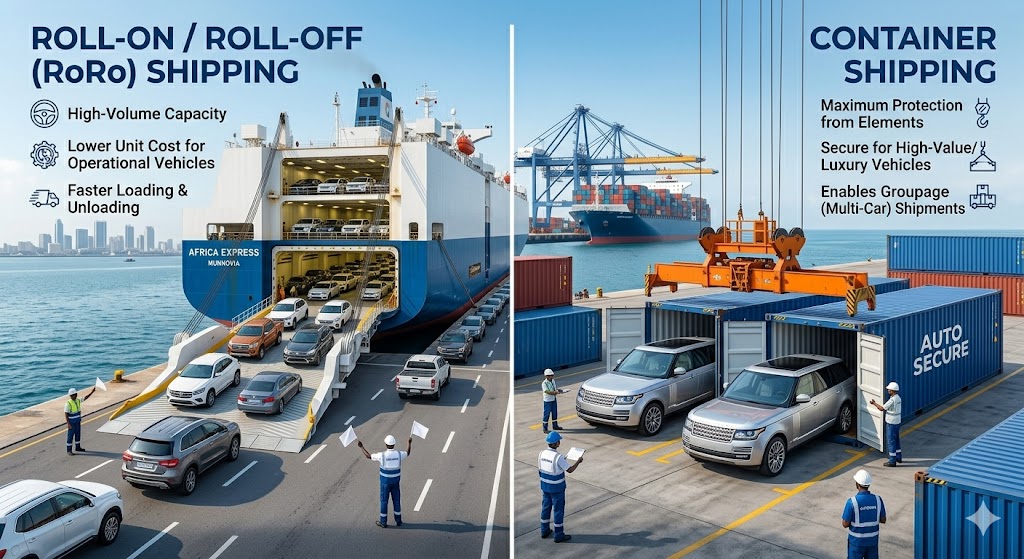
Most accidented vehicles are shipped via RoRo (Roll-on/Roll-off) , which is more cost-effective than container shipping.
Shipping steps:
- Arrange pickup from auction yard (must be done within 3 days to avoid $50/day storage fees)
- Inland trucking to US port (Houston, Baltimore, or Savannah)
- US Customs export clearance
- Ocean transit to Apapa or Tin Can Island Port (4-8 weeks)
Important for accidented vehicles: If your vehicle is non-operational due to damage, ensure your shipping company knows. Non-running vehicles require special handling and may incur higher fees or require container shipping.
Step 6: Customs Clearance for Accidented Vehicles
Accidented vehicles have a significant advantage at customs: lower valuation.
According to freight forwarding experts, the degree of damage is considered during assessment, and accidented vehicles can receive rebates of 40-50% compared to clean-title vehicles .
The key: “When you are doing your assessment, you have to state the position of the vehicle, the state of the vehicle, so as to justify the value that you are actually putting on it” .
Required documents:
- Bill of Lading
- Commercial invoice (showing accident damage)
- Form M (opened before vessel departure)
- PAAR
- Auction condition report (to prove damage level)
Step 7: Repairing Accidented Vehicles in Nigeria
Once cleared, the vehicle moves to the repair stage. Nigeria has a robust ecosystem of skilled mechanics and auto body shops that specialize in restoring accidented vehicles at competitive rates .
| Repair Type | Estimated Cost (₦) |
|---|---|
| Front end (bumper, grille, lights) | 150,000 – 400,000 |
| Rear end | 100,000 – 300,000 |
| Door replacement (per door) | 80,000 – 200,000 |
| Complete respray | 200,000 – 600,000 |
| Air conditioning service | 50,000 – 150,000 |
Example: A crashed Mercedes-Benz C300 was recently restored by a Nigerian mechanic team. The transformation involved replacing the rear bodywork, panel beating, and repainting. The result looked like a brand new vehicle .
Step 8: Registration and Sale
After repairs are complete, the vehicle must be registered with the FRSC before it can be legally driven or sold.
Registration steps:
- Vehicle inspection at VIS centre
- Customs Form C250
- FRSC registration and number plates
Complete Landed Cost Example: Accidented Toyota Camry
| Component | Amount (USD) | Amount (₦ at ₦1,500) |
|---|---|---|
| Winning bid (salvage) | $3,000 | ₦4,500,000 |
| Auction fees | $450 | ₦675,000 |
| Inland trucking | $400 | ₦600,000 |
| Ocean freight (RoRo) | $1,500 | ₦2,250,000 |
| CIF Value | $5,350 | ₦8,025,000 |
| Customs duty (reduced for accidented) | ~35% of CIF | ₦2,800,000 |
| Clearing agent fees | ₦300,000 | |
| Repair costs | ₦500,000 | |
| Registration | ₦150,000 | |
| Total Landed Cost | ₦13,875,000 |
Compare to clean-title import: ₦18–20 million
Saving: Approximately ₦5 million
Common Traps and How to Avoid Them
Trap 1: Flood-Damaged Vehicles from Hurricane States
The risk: Vehicles from Florida, Louisiana, and Texas flooded during hurricanes (Ian, Helene, Milton) are sold at low prices. Buyers unaware of the flood history purchase them, only to face electrical problems months after arrival.
Prevention: Check the Copart sale date against FEMA disaster declarations. If sold within 30 days after a named hurricane, assume flood damage .
Trap 2: Salvage Title Laundering Through Low-Documentation States
The risk: A vehicle with a salvage brand from Florida is re-titled in Oklahoma, Kentucky, Texas, or Georgia—states that do not carry the salvage brand forward for export vehicles. The vehicle appears to have a “clean” title.
Prevention: Run a NMVTIS-based VIN report. The original brand remains in the NMVTIS database regardless of re-titling .
Trap 3: Odometer Rollback
The risk: A 2020 Corolla showing 35,000 miles that actually traveled 120,000+ miles.
Prevention: The VIN report shows every reported odometer reading. Check for readings that decrease or do not increase plausibly .
Trap 4: Re-sprayed Color Hiding Accident History
The risk: A vehicle was damaged, repaired, and resprayed a different color. The Nigerian buyer sees no evidence of damage.
Prevention: The VIN report shows every color recorded at every US state title event. A color change between auctions indicates accident repair .
Frequently Asked Questions
Is it legal to import accidented cars into Nigeria?
Yes. Nigeria does not explicitly prohibit the importation of salvage or accidented vehicles. However, there are restrictions on vehicles older than 10 years .
Do accidented cars pay less customs duty?
Yes. Accidented vehicles can receive duty rebates of 40-50% compared to clean-title vehicles because their value is assessed lower due to damage .
Which US states should I avoid for sourcing accidented cars?
Exercise extreme caution with vehicles from Florida, Louisiana, and Texas, particularly those sold at auction within 30 days after a hurricane. These have high flood damage risk .
Can a car with frame damage be imported?
Technically yes, but it is not recommended. Frame damage compromises vehicle safety, and proper repairs are expensive. Most experienced importers avoid frame-damaged vehicles .
How much does it cost to repair an accidented car in Nigeria?
Depending on damage severity, expect to spend between ₦200,000 and ₦1,000,000 on repairs. Minor front or rear damage typically costs ₦150,000–₦400,000 .
Is it better to buy a clean title or accidented car?
If you have the budget and want minimal risk, a clean title is better. If you have access to skilled mechanics and want maximum savings, accidented cars can be profitable .
Conclusion
Importing accidented cars from the US to Nigeria is a well-established trade that offers significant economic advantages. The price differential between US salvage auctions and Nigerian used car prices creates opportunities for substantial savings—but only when executed correctly.
The keys to success are:
- Choose the right damage: Minor, non-structural damage only. Avoid flood, frame, and major engine damage
- Verify before bidding: Run a VIN history report to catch title laundering, flood history, and odometer rollback
- Understand the duty advantage: Accidented vehicles attract lower customs valuation
- Budget for repairs: Skilled Nigerian mechanics can restore vehicles cost-effectively
- Work with trusted partners: From US brokers to Nigerian clearing agents, your partners determine your success
For importers who prefer to delegate the complexity to experienced professionals, Autoriva provides end-to-end services—from identifying suitable accidented vehicles at Copart and IAAI to bidding, shipping coordination, customs clearance, and delivery.
Ready to import accidented vehicles profitably? Contact Autoriva today for a consultation and personalized cost estimate.