
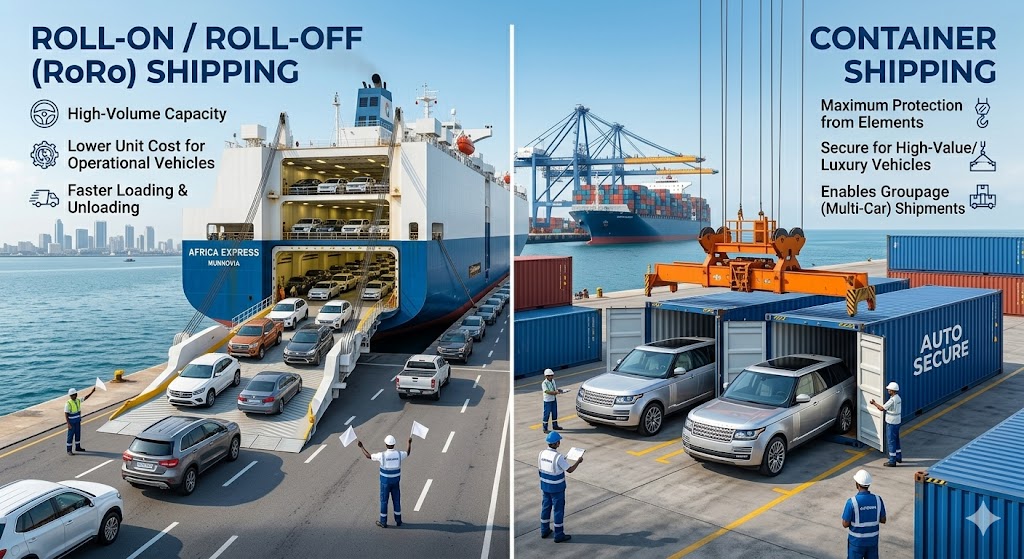
Your vehicle has crossed the Atlantic. After weeks of waiting, the vessel has arrived off the coast of Lagos. But the journey is not over. Before you can drive your car on Nigerian roads, it must be discharged, cleared by Customs, and delivered from the port.
And here is a critical question that can significantly affect both your cost and waiting time: Which port will your vehicle be delivered to—Apapa (Lagos Port) or Tin Can Island Port?
The choice of port is not always in your hands. It is determined by the shipping line, the carrier, and the terminal where your vehicle is discharged. However, understanding the differences between these two ports enables you to make informed decisions when booking shipping and selecting a clearing agent.
Apapa Port is Nigeria’s oldest, largest, and busiest seaport, handling over 50% of the nation’s imports . It is managed by APM Terminals and has long been the primary gateway for goods entering Nigeria. However, it is also notoriously congested, with chronic truck traffic, infrastructure challenges, and clearance delays.
Tin Can Island Port, located adjacent to Apapa, is slightly newer and has carved out a specialization in Roll-on/Roll-off (RoRo) cargo—specifically, vehicles and heavy equipment. The PTML (Ports and Terminal Multiservices Limited) terminal within Tin Can is widely recognized by experienced importers as the premier facility for vehicle clearance in Nigeria.
This guide provides a comprehensive, side-by-side comparison of Apapa Port and Tin Can Island Port specifically for car importers. You will learn about clearance times, costs, terminal specialization, congestion levels, customs processes, and—most importantly—which port offers the fastest, most cost-effective clearance for your imported vehicle.
By the conclusion of this guide, you will be equipped to choose the right port for your shipment, select the right shipping line, and work with the right clearing agent to minimize demurrage charges and get your vehicle on the road faster.
Overview of Nigeria’s Port System
Nigeria’s maritime trade is concentrated in Lagos, where the ports of Apapa, Tin Can Island, and Lekki handle the vast majority of the country’s imports .
Context of Nigeria’s Port Competitiveness
Nigerian ports—including both Apapa and Tin Can—face significant competitiveness challenges compared to regional peers. Container dwell times at Nigerian ports average between 18 and 21 days, among the highest globally, far above the roughly four-day benchmark seen in more efficient systems .
A container at Apapa can remain immobile for up to 30 days, compared to 12 days at Cotonou in neighboring Benin . As a result, approximately 90% of cargo that arrives at the ports of Cotonou and Lomé (Togo) ultimately ends up in Nigeria—transported by road after being cleared in countries with more efficient ports .
This context is essential for understanding why port selection matters. The inefficiencies are systemic, but within the system, Tin Can’s PTML terminal has distinguished itself as a relative bright spot for vehicle imports.
The Two Primary Lagos Ports
Nigerian Ports Authority (NPA) Oversight
Both ports are controlled by the Nigerian Ports Authority (NPA), the government agency responsible for regulating and managing port operations across the country . The NPA has announced plans to modernize both Apapa and Tin Can ports, with officials aiming to reduce cargo dwell time from up to 21 days to under seven days by 2026 .
Additionally, the Nigeria Customs Service has launched the National Single Window (NSW) digital platform to streamline documentation and customs procedures across multiple agencies, though implementation has experienced network glitches affecting operations .
Apapa Port (Lagos Port) — In-Depth Analysis
History and Overview
Apapa Port is Nigeria’s oldest and most active seaport. Originally built in the 1920s, it has expanded over decades to become the primary gateway for Nigerian imports. The port is managed by APM Terminals, a global terminal operator known for efficiency and reliability in other markets .
Apapa handles over 50% of Nigeria’s imports . Its facilities include five private terminals handling containerized cargo, bulk goods, and some vehicle imports. The port’s sheer volume makes it the busiest in West Africa in terms of container throughput.
Infrastructure and Facilities
Terminals:
- APM Terminals (primary container operator)
- Four other private terminals handling various cargo types
Cargo Types: Containerized goods, bulk cargo, some RoRo vehicles
Equipment: Modern container cranes, yard equipment (variable condition)
Connectivity: Road access to Lagos-Ibadan expressway; rail link to Lagos-Ibadan standard gauge railway
Vehicle Clearance at Apapa
For vehicle importers, Apapa presents a mixed picture. While the port can handle vehicles—typically through containerized shipments or RoRo vessels—it is not specialized for this purpose.
How vehicles are processed at Apapa:
- RoRo vehicles: Discharged at general cargo berths not specifically designed for vehicle handling
- Containerized vehicles: Processed through container terminals
- Inspection: Customs examinations occur at general inspection areas
Clearance time: 5–14+ days depending on congestion and documentation
Typical experience: Apapa’s high traffic volume and congestion can lead to significant delays. Even when customs processing is efficient, outbound logistics (truck access, gate procedures) often slow down the overall process .
Congestion and Road Access
Apapa is notorious for chronic congestion . The port was built decades ago and has struggled to cope with rising cargo volumes, larger vessels, and—most significantly—chronic congestion on access roads .
Key congestion factors:
- Heavy truck traffic: Thousands of trucks queue daily to access the port
- Poor road conditions: Access roads are frequently in poor repair
- Multiple checkpoints: Security and administrative checkpoints slow movement
- Limited holding areas: Insufficient truck parks outside the port
Government response: The Nigeria Customs Service has issued ultimatums on truck evacuation, including a presidential directive on clearing trucks from roads leading to Apapa . However, congestion remains a persistent challenge.
For car importers, this means that even after customs clearance, simply getting a truck into the port to collect your vehicle can add days to the timeline.
Recent Performance Issues
Apapa has been affected by the network glitches on the Nigeria Customs Service’s B’Odogwu digital platform. In mid-2025, cargo clearing activities were significantly disrupted, leaving over 5,000 containers trapped across Apapa, Tin Can, and PTML ports .
For vehicle importers, demurrage charges during such disruptions can be substantial:
Pros and Cons of Apapa for Car Imports
Tin Can Island Port — In-Depth Analysis
History and Overview
Tin Can Island Port, located adjacent to Apapa, was built in the 1970s to relieve pressure on the older Apapa facility. It is slightly newer than Apapa and has developed distinct specializations.
The port is operated by multiple terminal operators, including Five Star Logistics, Tin Can Island Container Terminal (TICT), and—most importantly for car importers—Ports and Terminal Multiservices Limited (PTML).
Tin Can Island Port, together with Apapa, concentrates approximately 70% of Nigeria’s freight imports .
PTML Terminal — The Crown Jewel for Car Importers
The PTML (Ports and Terminal Multiservices Limited) terminal is the most important facility at Tin Can for vehicle importers. PTML is a specialized Roll-on/Roll-off terminal designed specifically for vehicle handling .
PTML specialization: RoRo cargo such as cars, trucks, heavy equipment, and machinery .
- Phone: +234 (0)1 2790 880-3
- Email: [email protected]
- Website: www.ptml-nigeria.com
Major shipping lines using PTML: Grimaldi Lines, Höegh Autoliners, and other RoRo carriers .
Infrastructure and Facilities
Terminal operators at Tin Can:
- PTML — Specialized RoRo vehicle terminal
- Five Star Logistics — General cargo and containers
- Tin Can Island Container Terminal (TICT) — Containerized cargo
- Josepdam Port Service Ltd
PTML advantages for vehicles:
- Dedicated RoRo berths designed for vehicle discharge
- Ramps designed for safe vehicle handling
- Personnel trained specifically in vehicle securement and movement
- Streamlined inspection processes for vehicles
- Proximity to shipping company offices facilitates document processing
Vehicle Clearance at Tin Can — PTML Advantage
PTML has achieved remarkable clearance times for vehicles, significantly outperforming industry averages.
Achieved clearance times: Cargo clearance at PTML has dropped to six hours for consignments with genuine, honest documentation .
Context: Previously, vehicle clearance took at least three to six days before exiting the port terminal. The reduction to six hours represents a dramatic improvement .
How six-hour clearance is achieved:
- Proactive mechanisms by the terminal operator and Nigeria Customs Service
- Proximity of shipping company and terminal offices
- Open-door policy of Customs Area Controller who addresses complaints promptly
- Challenges are treated within an hour under the command
Container clearance at PTML: Even containers can exit the terminal within 24 hours if documentation is intact .
Key success factor: Freight agents emphasize that six-hour clearance is possible for genuine and honest documentation. Importers who have all paperwork correct and complete benefit from the streamlined process .
Congestion and Road Access
Tin Can generally experiences less congestion than Apapa, though it is not immune to port-wide challenges.
Advantages over Apapa:
- Fewer trucks queuing for access
- More modern layout
- Specialized terminals reduce cross-traffic
Remaining challenges:
- Road access still affected by Lagos traffic
- Can experience bottlenecks during peak seasons
- Relies more heavily on road transport (no direct rail link to inland destinations, unlike Apapa)
Recent Performance and Challenges
Tin Can has not been immune to Nigeria’s broader port challenges. The PTML terminal was affected by the network glitches on the Customs B’Odogwu platform, with some cargo trapped alongside Apapa .
However, PTML’s specialized nature and strong working relationships between terminal operators and Customs have allowed it to recover faster than general cargo terminals.
Pros and Cons of Tin Can (PTML) for Car Imports
Side-by-Side Comparison: Apapa vs Tin Can for Car Imports
Clearance Time Comparison
| Port | Best Case | Typical Range | Worst Case |
|---|---|---|---|
| Apapa | 5-7 days | 7-14 days | 21+ days |
| Tin Can (PTML) | 6 hours | 1-3 days | 7-10 days |
This is the most significant difference between the two ports. PTML has achieved clearance times that are an order of magnitude faster than Apapa’s best-case scenarios.
Why PTML is faster:
- Specialized RoRo terminal designed specifically for vehicles
- Streamlined customs processes for vehicle documentation
- Proximity of shipping company offices to the terminal
- Open-door policy of Customs Area Controller
- Terminal operator and Customs working in coordination
Cost Comparison
Demurrage calculations:
- Daily car demurrage: N10,000 per day
- At Apapa (14+ day clearance): N140,000+ potential demurrage
- At Tin Can (1-3 day clearance): N10,000-30,000 potential demurrage
Potential savings: Clearing through Tin Can rather than Apapa can save N100,000 or more in demurrage charges alone.
Infrastructure and Handling
Connectivity
| Aspect | Apapa | Tin Can |
|---|---|---|
| Road access | Poor (severe congestion) | Better (less congestion) |
| Rail connectivity | Yes (Lagos-Ibadan railway) | No direct rail |
| Proximity to shipping lines | Variable | Excellent at PTML |
Note on rail connectivity: Apapa’s rail link provides an advantage for importers moving large volumes inland. For individual car imports, this is less relevant than for commercial quantities.
Regulatory and Customs Environment
Expert note: For importers unfamiliar with clearing agents or the local business environment, Apapa might prove safer as it offers more predictable outcomes and fewer surprises in the clearing process .
PTML Terminal: The Gold Standard for Vehicle Imports
The PTML terminal at Tin Can Island Port deserves special attention as the premier facility for vehicle importation in Nigeria.
What Makes PTML Different
Specialized RoRo Focus: Unlike general cargo terminals that handle whatever arrives, PTML is designed exclusively for Roll-on/Roll-off cargo. This specialization means every aspect of the operation—from berth design to staff training to inspection processes—is optimized for vehicles .
Six-Hour Clearance Achievement: PTML has demonstrated that with proper documentation, a vehicle can clear customs and exit the terminal within six hours of vessel discharge . This is exceptional by any global standard and extraordinary in the Nigerian context.
- All necessary documentation can be completed before the vessel arrives
- Proximity between shipping company offices and the terminal
- Customs officials who address challenges within an hour
- Terminal operator and Customs working in coordination
- Open-door policy for addressing complaints
Container Clearance: Even for containerized vehicle shipments, PTML can process containers within 24 hours for those with correct documentation .
Shipping Lines Using PTML
Major RoRo carriers that deliver to PTML include:
Practical implication: When booking shipping from the US, Europe, or UAE, you can request carriers that use PTML as their Lagos destination. This puts you in the faster clearance channel.
Documentation Requirements at PTML
To achieve six-hour clearance, freight agents emphasize that documentation must be genuine and honest . This means:
- Form M opened before vessel departure
- PAAR obtained and accurate
- Commercial invoice reflecting true transaction value
- Bill of Lading with correct consignee details
- No discrepancies between documents
PTML Contact and Operations
- Operator: Ports and Terminal Multiservices Limited (PTML)
- Parent company: Grimaldi Group
- Location: Tin Can Island Port, Lagos
- Specialization: RoRo cargo (vehicles, heavy equipment, machinery)
How Port Choice Affects Your Total Import Cost
Direct Cost Comparison
Example: Importing a Toyota Camry
Indirect Cost Considerations
Time value: Faster clearance means you can sell or use your vehicle sooner. For commercial importers turning over multiple vehicles, this significantly improves cash flow.
Storage risk: Each day your vehicle sits at the port increases risk of damage, theft, or administrative complications.
Agent relationships: Clearing agents familiar with PTML’s efficient processes can further accelerate clearance. Agents accustomed to Apapa’s slower pace may not leverage PTML’s advantages fully.
Hidden Costs by Port
- Trucking delays due to congestion
- “Extortion” or unofficial fees at checkpoints
- Longer agent engagement times (higher fees)
- Potential for missed delivery windows
- If documentation is incorrect, delays can still occur
- Less rail connectivity for inland transport
- May require more experienced agent to maximize efficiency
Which Port Do Major Shipping Lines Use?
RoRo Carriers to Nigeria
| Carrier | Primary Lagos Terminal | Port |
|---|---|---|
| Grimaldi Lines | PTML | Tin Can |
| Höegh Autoliners | PTML | Tin Can |
| Wallenius Wilhelmsen | PTML/Tin Can | Tin Can |
| MSC (container) | Apapa or Tin Can | Both |
| Maersk (container) | Apapa | Apapa |
Container Carriers
Containerized vehicle shipments are more flexible and can be delivered to either port depending on the carrier’s terminal arrangements.
Observation: When shipping RoRo (the most common method for Nigerian importers), you are likely to be directed to PTML at Tin Can Island Port through carriers like Grimaldi and Höegh Autoliners.
How to Request a Specific Port
When booking shipping through your freight forwarder, ask:
- “Which Lagos terminal does this carrier use—Apapa or Tin Can (PTML)?”
- “Is delivery to PTML available for my shipment?”
- “What is the difference in cost between delivery to Apapa vs Tin Can?”
In many cases, the choice is determined by the carrier’s schedule and terminal agreements, but understanding your options allows you to make informed decisions.
Recent Developments and 2026 Updates
Digital Transformation (National Single Window)
Nigeria launched the first phase of its National Single Window (NSW) digital trade platform, designed to streamline documentation and customs procedures across multiple agencies .
Impact on ports: The reform aims to reduce cargo dwell time from up to 21 days to under seven days by 2026 .
Current status: Implementation has experienced network glitches. In mid-2025, the B’Odogwu platform experienced persistent network issues, leaving over 5,000 containers trapped across Apapa, Tin Can, and PTML ports .
Demurrage during disruptions :
- 40ft container: N120,000-140,000/day
- 20ft container: N80,000/day
- Cars: N10,000/day
- Trucks: N35,000/day
Infrastructure Modernization Plans
Officials have announced plans to upgrade both Apapa and Tin Can ports, which were built decades ago and have struggled with rising cargo volumes and larger vessels .
Expected outcomes: Reduced congestion, improved road access, and more efficient cargo processing.
Customs Enforcement
The Nigeria Customs Service has issued ultimatums on clearing overtime cargoes at both ports. In August 2025, Customs gave a 14-day ultimatum to clear 905 overtime cargoes at Apapa, Tin Can, and PTML commands .
For importers: This underscores the importance of prompt clearance and avoiding storage of vehicles at the port.
Practical Recommendations for Car Importers
When to Choose Tin Can (PTML)
Choose Tin Can PTML if:
- You are shipping a vehicle via RoRo (most common for Nigerian imports)
- Your carrier offers delivery to PTML (Grimaldi, Höegh Autoliners, etc.)
- You have all documentation prepared correctly (Form M, PAAR, etc.)
- You are working with an experienced clearing agent
- Speed of clearance is your priority
- You want to minimize demurrage charges
Tin Can is particularly strong for:
- Standard used vehicles (Toyota, Honda, Lexus, Mercedes)
- RoRo shipments
- Importers with correct, honest documentation
- Those who value efficiency over established processes
When to Choose Apapa
Choose Apapa if:
- You are shipping via container rather than RoRo (some carriers default to Apapa)
- Your vehicle is part of a larger containerized shipment
- You are a first-time importer and prefer more standardized procedures
- Your clearing agent has specific expertise at Apapa
- You need rail connectivity for inland transport
Apapa may be preferable for:
- Containerized vehicle shipments
- New importers unfamiliar with the system (more predictable outcomes)
- Commercial quantities requiring rail transport
- When your shipping line does not offer PTML delivery
How to Get Your Vehicle to the Better Port
Action steps:
- Before shipping: Ask your freight forwarder which Lagos terminal the carrier uses
- Select carriers that use PTML: Grimaldi and Höegh Autoliners are known to deliver to PTML
- Ensure documentation is perfect: Six-hour clearance at PTML requires genuine, honest documentation with zero discrepancies
- Engage an agent with PTML experience: Not all clearing agents are equally familiar with PTML’s efficient processes
Working with Clearing Agents
Frequently Asked Questions
Which port is better for importing cars to Nigeria—Apapa or Tin Can?
Tin Can Island Port (specifically the PTML terminal) is generally better for car imports. It offers specialized RoRo handling, faster clearance times (as low as six hours with correct documentation), and lower demurrage risk . However, the choice ultimately depends on which port your shipping line uses.
How long does it take to clear a car at PTML Tin Can?
With correct, honest documentation, a vehicle can clear PTML and exit the terminal within six hours of vessel discharge . Containerized vehicles can clear within 24 hours .
How long does it take to clear a car at Apapa Port?
Typical clearance at Apapa ranges from 5 to 14 days or longer, depending on congestion and documentation . Apapa is Nigeria’s most congested port .
Which port has lower costs for car importers?
Tin Can (PTML) generally has lower costs because:
- Terminal handling charges are lower for vehicles
- Faster clearance reduces demurrage charges (N10,000/day saved)
- Less congestion reduces trucking delays
Can I choose which port my car is delivered to?
You cannot directly choose, but you can choose shipping lines that deliver to your preferred port. Carriers like Grimaldi and Höegh Autoliners deliver to PTML at Tin Can . When booking shipping, ask your freight forwarder about the destination terminal.
What is PTML and why is it important for car imports?
PTML (Ports and Terminal Multiservices Limited) is a specialized Roll-on/Roll-off terminal at Tin Can Island Port. It is designed specifically for vehicle handling and has achieved clearance times as low as six hours for cars with correct documentation . Major RoRo carriers like Grimaldi and Höegh Autoliners use PTML .
Is Apapa Port safe for car imports?
Yes, Apapa is safe but slower and more congested. It is Nigeria’s oldest and busiest port, handling over 50% of national imports . While it has established processes familiar to many agents, its chronic congestion and lack of vehicle specialization mean longer clearance times .
How does the new National Single Window affect port clearance?
The National Single Window (NSW) digital platform aims to reduce cargo dwell times from up to 21 days to under seven days by 2026 . However, implementation has experienced network glitches .
What is the demurrage charge for cars at Nigerian ports?
Demurrage for a car is N10,000 per day after the free storage period expires . Trucks attract N35,000 per day, and caterpillars N45,000 per day .
Conclusion
Choosing between Apapa Port and Tin Can Island Port for your car import is a decision that can significantly affect both your costs and how quickly you receive your vehicle.
Tin Can Island Port (PTML) is the superior choice for most vehicle importers. Its specialized RoRo terminal has achieved clearance times as low as six hours , compared to Apapa’s typical 5-14 days . Lower terminal handling charges , reduced demurrage risk (N10,000/day saved) , and less congestion make it the preferred destination for experienced importers.
Apapa Port remains a viable option for containerized shipments, importers whose shipping lines do not offer PTML delivery, or those who prefer more standardized procedures . Its rail connectivity provides an advantage for moving large volumes inland .
The key to success at either port is preparation. Ensure your documentation is perfect—Form M opened before vessel departure, PAAR obtained, commercial invoice accurate. Work with a clearing agent who knows the specific port’s processes. And when possible, choose shipping lines that deliver to PTML at Tin Can Island Port.
Key Takeaways
For importers who prefer professional assistance navigating port selection, shipping coordination, and customs clearance, Autoriva provides end-to-end import services. We help clients choose carriers that deliver to PTML, ensure documentation is perfect for fast clearance, and coordinate with experienced clearing agents at the optimal port for vehicle imports.
Ready to import your vehicle through the best Lagos port? Contact Autoriva today for a consultation and personalized import plan. We will help you avoid costly delays and get your vehicle on Nigerian roads faster.