
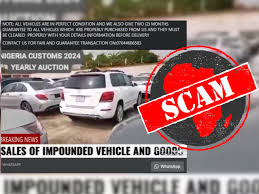
Every year, Nigerian car buyers lose hundreds of millions of naira to import scams.
The victims are not naive or careless people. They are professionals, business owners, and families who saved for months or years to import a vehicle. They chose what appeared to be legitimate agents or online sellers. They made payments in good faith. And then, in a matter of days or weeks, their money disappeared.
Some scams are sophisticated—complete with fake websites, forged documents, and convincing phone conversations. Others are crudely executed but still effective because they prey on urgency and the desire for a good deal.
The common thread across all import scams is this: the scammer exploits information asymmetry. They know more about the import process than you do, and they use that knowledge to manipulate you.
This guide is designed to close that information gap. You will learn the nine most critical red flags that indicate a car import scam, the tactics scammers use at each stage of the import process, and the practical steps you can take to protect your investment.
By the conclusion of this guide, you will be equipped to distinguish between legitimate service providers and fraudulent operators, enabling you to import your vehicle with confidence.
The Landscape of Car Import Scams in Nigeria
Understanding the broader context helps you recognise why car import scams are prevalent and how they operate.
Why Car Importation Attracts Scammers
Several factors make vehicle importation a fertile ground for fraudulent activity:
- High transaction values: Vehicle imports typically involve payments of millions of naira or tens of thousands of dollars. A single successful scam yields significant returns.
- Complex processes: The multi-stage nature of importation—auction bidding, shipping, customs clearance, registration—creates opportunities for fraud at each stage.
- Information gaps: Many buyers do not fully understand the process, making them dependent on agents who claim expertise.
- Cross-border complexity: Transactions involving international wire transfers, foreign currencies, and overseas parties are harder to trace and recover than local payments.
- Urgency and emotion: Buyers are often excited or anxious about their vehicle, making them more susceptible to pressure tactics.
Types of Car Import Scams
Scams fall into several categories, each targeting a different stage of the import process.
| Scam Type | Target Stage | Typical Loss |
|---|---|---|
| Fake auction or vehicle listing | Pre-purchase | Full vehicle price |
| Phantom agent scam | Shipping or clearance | Partial or full payment |
| Document forgery | Customs clearance | Imprisonment or vehicle seizure |
| Bait-and-switch | Delivery | Difference in vehicle value |
| Customs impersonation | Duty payment | Duty amount paid to fraudster |
The red flags discussed in this guide apply across all these scam types.
Red Flag 1: Prices That Are Significantly Below Market Value
The oldest principle in commerce remains the most reliable indicator of fraud: if it seems too good to be true, it almost certainly is.
What to Look For
A 2020 Toyota Camry listed at $4,000. A 2019 Lexus RX at $7,000. A 2021 Honda Accord at $5,500. These prices are substantially below established market values at reputable auctions like Copart or IAAI.
Scammers advertise below-market prices to attract attention and create a sense of opportunity. They rely on the buyer’s desire to secure a “deal” before someone else does.
How the Scam Operates
The scammer posts attractive listings on social media (Facebook, Instagram, WhatsApp), classified sites (Jiji, OLX, Craigslist), or fake websites. When you express interest, they explain the low price as:
- “Salvage title with minor damage”
- “Bank repossession, bank wants quick sale”
- “Owner urgent sale, relocating overseas”
- “Customs seizure auction, government wants fast clearance”
These explanations sound plausible to buyers unfamiliar with how legitimate auctions price vehicles.
How to Protect Yourself
- Research current market prices: Before engaging any seller, check completed auction prices for the same make, model, year, and condition on Copart or IAAI. Legitimate sellers price within market ranges.
- Understand salvage and rebuilt values: A salvage vehicle is typically priced at 25% to 40% of a clean-title vehicle. Extremely low prices on salvage vehicles are still suspicious.
- Request the VIN: A legitimate seller will provide the Vehicle Identification Number (VIN) immediately. Run the VIN through Carfax or Autocheck to verify history and ownership.
- Compare across multiple sources: If the same vehicle appears listed by different sellers or at different prices, it is almost certainly a scam.
Professional Recommendation
Autoriva provides clients with market price benchmarks before any bidding or purchase. If a price falls significantly outside the normal range, we flag it as a potential risk.
Red Flag 2: Pressure to Pay Quickly or “Reserve” the Vehicle
Scammers understand that deliberation is the enemy of fraud. The more time you take to verify, the more likely you are to discover inconsistencies.
What to Look For
Messages or calls that include phrases such as:
- “Five other buyers are interested. Pay now to secure it.”
- “This price is only valid for 24 hours.”
- “The auction closes today. Send payment immediately.”
- “I have another buyer ready with cash. Decide now.”
Any request for urgent payment—particularly without adequate time for verification—is a significant red flag.
How the Scam Operates
The scammer creates artificial scarcity. They want you to bypass your normal verification process and send money before you have time to think critically. Once payment is sent, the scammer becomes unreachable.
How to Protect Yourself
- Never pay immediately: Legitimate auctions and agents do not require instant payment without documentation. Copart, IAAI, and Manheim provide invoices with payment deadlines of 2 to 5 days.
- Insist on verification time: A legitimate counterparty will not object to you taking 24 to 48 hours to verify their credentials and the vehicle’s existence.
- Verify before payment: Confirm that the vehicle exists, that the seller is legitimate, and that the payment method is traceable.
Professional Recommendation
Autoriva never asks clients to make immediate, irreversible payments without complete documentation. We provide invoices, confirm vehicle availability, and allow reasonable time for review.
Red Flag 3: Request for Payment via Untraceable Methods
Legitimate vehicle transactions leave an audit trail. Scammers prefer payment methods that cannot be traced or reversed.
What to Look For
Requests to pay via:
- Cryptocurrency (Bitcoin, USDT, Ethereum)
- Cash deposit to a personal bank account
- Wire transfer to an individual’s name (rather than a company account)
- Gift cards (iTunes, Google Play, Amazon)
- Western Union or MoneyGram
- Mobile money transfers (to personal lines)
How the Scam Operates
These payment methods offer little to no consumer protection. Once funds are sent, they cannot be reversed. The scammer can withdraw the money and disappear without leaving traceable information.
Legitimate auction houses and shipping companies accept bank transfers to corporate accounts with verifiable registrations. They do not request cryptocurrency or gift cards.
How to Protect Yourself
- Verify the receiving entity: Before sending any wire transfer, confirm that the account name matches the registered business name of the auction house, shipping line, or agent.
- Use traceable methods: Bank transfers to corporate accounts leave a clear audit trail. Credit card payments (where accepted) offer additional dispute rights.
- Be suspicious of personal accounts: If the agent asks you to pay into a personal savings or current account rather than a corporate domiciliary account, investigate further.
What Legitimate Payments Look Like
| Payment Type | Typical for |
|---|---|
| Bank transfer to corporate account | Auction houses, shipping lines, Autoriva |
| Credit card (online) | Auction registration and small deposits |
| Escrow service (rare in auto auctions) | High-value private sales |
Red Flag 4: Agent or Company Cannot Provide Verifiable Credentials
Anyone can claim to be a licensed customs agent or freight forwarder. Verifiable credentials separate legitimate operators from fraudsters.
What to Look For
- Inability or refusal to provide a registration number with CRFFN (Council for the Regulation of Freight Forwarding in Nigeria)
- No physical office address (only WhatsApp or social media presence)
- No verifiable business registration with the Corporate Affairs Commission (CAC)
- No references from past clients that you can actually contact
- Vague answers when asked about their licence or qualifications
How the Scam Operates
The scammer operates entirely online, often using a mobile phone and a stock photo as a profile picture. They have no physical presence, no registration, and no track record. After receiving payment, they close the phone line or block the victim.
How to Protect Yourself
- Request CRFFN registration: Every legitimate customs agent in Nigeria must be registered with CRFFN. Ask for the registration number and verify it directly with CRFFN.
- Request CAC registration: For companies claiming to be import or logistics firms, obtain their CAC registration number and verify through the CAC public search portal.
- Visit a physical office: Legitimate companies have physical addresses. If possible, visit the office before engaging their services. For companies outside your city, request a video tour of the office.
- Speak to past clients: Request contact information for two or three previous clients. Call them and ask about their experience.
- Check online reputation: Search for the company name followed by words like “scam,” “complaint,” “review,” or “fraud.” Legitimate companies will have some online presence, even if imperfect.
What Autoriva Provides
Autoriva is a registered business with verifiable physical offices. We provide our CAC registration, client references upon request, and a transparent online presence including this blog and our website at autoriva.africa.
Red Flag 5: Fake or Suspicious Auction Websites
Scammers create convincing copies of legitimate auction websites to collect login credentials and payments.
What to Look For
- URLs that resemble legitimate sites but have small differences (e.g., “copart-auction.com” instead of “copart.com“)
- Poor grammar, spelling errors, or awkward phrasing on the website
- No HTTPS (padlock icon) on the payment page
- Request to create an account and deposit funds before bidding
- Unusually low “buy it now” prices on desirable vehicles
- Payment instructions that differ from the official auction house’s published methods
How the Scam Operates
The scammer builds a fake website that mimics Copart, IAAI, or a smaller auction platform. They run ads on social media or Google to drive traffic. When you create an account and deposit funds, the money goes directly to the scammer. You may see a fake bidding interface, but no actual vehicle exists.
How to Protect Yourself
- Type the URL yourself: Never click links from unsolicited emails or messages. Type the official website address (e.g., www.copart.com) directly into your browser.
- Check the SSL certificate: Look for the padlock icon and verify that the certificate is issued to the legitimate company, not a generic issuer.
- Compare with official site: Open the official auction house website alongside the suspicious site. Differences in logo quality, layout, or contact information are telltale signs.
- Contact the auction house directly: Call the official customer service number (found on their real website) and ask if the suspicious site is affiliated with them.
Official Auction Websites
| Auction House | Official URL |
|---|---|
| Copart | copart.com |
| IAAI (IAA) | iaai.com |
| Manheim | manheim.com |
| ACV Auctions | acvauctions.com |
Red Flag 6: Refusal to Provide the VIN Before Payment
The Vehicle Identification Number (VIN) is the unique identifier for every car ever manufactured. It unlocks the vehicle’s history, ownership records, damage reports, and title status.
What to Look For
A seller who:
- Refuses to provide the VIN unless you make a deposit
- Provides a VIN that is missing digits or contains invalid characters
- Provides a VIN that does not match the vehicle description when searched
- Claims the VIN is “confidential” or “only available after payment”
How the Scam Operates
The scammer does not have a real vehicle to sell. They may have copied photos from a legitimate listing but cannot produce a VIN because there is no car. Alternatively, they may provide a fake VIN or a VIN from a completely different vehicle.
How to Protect Yourself
- Never pay without a VIN: The VIN is free information. Any seller who withholds it is likely fraudulent.
- Run a VIN history report: Use Carfax, Autocheck, or a similar service. These reports reveal:
- Title status (clean, salvage, rebuilt, flood)
- Accident history
- Odometer readings
- Previous ownership locations
- Whether the vehicle was reported stolen
- Verify the VIN format: A valid VIN has 17 characters, no letters I, O, or Q (to avoid confusion with numbers), and a check digit in position 9.
What a VIN Search Reveals
| Information | Legitimate Use | Scam Indicator |
|---|---|---|
| Title brand (clean/salvage) | Confirms vehicle status | No title record found |
| Accident history | Validates damage claims | No history at all |
| Odometer readings | Verifies mileage claims | Rollback suspected |
| Theft record | Confirms legality | Reported stolen |
Autoriva provides VIN checks as part of our vehicle sourcing service, ensuring you have complete history before any payment is made.
Red Flag 7: Agent Demands Full Payment Before Any Service Is Rendered
Legitimate service providers structure payments to align with service delivery. Scammers demand full payment upfront.
What to Look For
- Request for 100% of shipping or clearing fees before any work has begun
- No option for milestone-based or stage-based payments
- Refusal to accept payment after service completion
- Pressure to pay “registration fees” before the vehicle has arrived
How the Scam Operates
The scammer collects full payment for services they never intend to perform. After payment, they become increasingly difficult to reach. Eventually, they stop responding entirely. The victim has no recourse because the payment was made without any service delivered.
How to Protect Yourself
- Insist on milestone payments: Legitimate agents accept payment structures such as:
- 30% to 50% upon engagement
- Remaining balance upon delivery or specific milestones
- Escrow arrangements: For large transactions, consider using an escrow service that releases funds only when both parties confirm satisfactory completion.
- Pay after service for trusted relationships: With agents you have used successfully before, you may negotiate post-service payment for certain fee components.
What Legitimate Payment Structures Look Like
| Service | Typical Payment Structure |
|---|---|
| Auction bidding | 100% of vehicle cost plus fees after winning bid |
| Shipping | 100% before vessel departure (industry standard) |
| Customs clearance | 50% engagement, 50% after delivery |
| Registration | 100% upon completion of registration |
Note that even legitimate shipping lines require full payment before sailing. The red flag is not prepayment itself—it is prepayment without verifiable documentation and established legitimacy.
Red Flag 8: Claims of “Special Connections” to Avoid Customs or Duties
No legitimate customs agent or import company can lawfully bypass Nigeria Customs Service duties, levies, or examination requirements.
What to Look For
- Claims such as “I know people at Customs, I can get your car out without paying full duty”
- Offers to clear your vehicle for a fraction of the official duty rate
- Promises of “no inspection” or “no examination” for an additional fee
- Claims that your vehicle can be cleared without Form M or PAAR
How the Scam Operates
The scammer exploits the desire to save money on customs duties. They collect a “discounted duty” payment from you, issue fake receipts or forged customs documents, and disappear. Alternatively, they pay a small bribe to have the vehicle moved temporarily, but when the fraud is discovered, the vehicle is seized by Customs.
The Reality
- All legally imported vehicles must pay duties based on the Nigeria Customs Service valuation.
- Form M and PAAR are mandatory. There are no exceptions.
- Physical examination occurs for many vehicles. It cannot be universally avoided.
- Attempting to evade duties is a criminal offence that can result in vehicle seizure, imprisonment, or both.
How to Protect Yourself
- Understand the official duty rates: Refer to our guide on clearing your car at Apapa Port for current duty calculations. Legitimate agents quote within these ranges.
- Be suspicious of “too low” estimates: If an agent quotes duties significantly below what Customs would assess, they are either misinformed or fraudulent.
- Verify payments with Customs: Request confirmation that your duty payment has been received by Nigeria Customs Service. Legitimate agents can provide a Customs Duty Payment Receipt.
Professional Recommendation
Autoriva provides transparent duty estimates based on current Customs valuation. We never promise to bypass or reduce lawful duties. Our role is to ensure you pay the correct amount—not less, and certainly not more.
Red Flag 9: No Written Contract or Service Agreement
Every legitimate business transaction should be documented with a written agreement that specifies scope, cost, timeline, and terms.
What to Look For
- Reliance on WhatsApp messages or verbal agreements as the only documentation
- No written contract specifying fees, services, or deliverables
- Refusal to provide a receipt or invoice for payments made
- Vague or missing terms about what happens if the vehicle is delayed or damaged
How the Scam Operates
Without a written agreement, the scammer has no obligation to you. They can change fees, add unexpected charges, delay indefinitely, or disappear entirely. You have no written evidence of what was promised or what you paid for.
Essential Elements of a Legitimate Service Agreement
| Element | Description |
|---|---|
| Scope of services | Exactly what the agent will do (bidding, shipping, clearance, registration) |
| Fee breakdown | Each cost component itemised |
| Payment terms | When payments are due and accepted methods |
| Timeline | Estimated completion dates for each stage |
| Dispute resolution | How disagreements will be handled |
| Company details | Legal name, registration number, physical address |
How to Protect Yourself
- Request a written agreement before paying: Do not make any payment without a signed contract or formal engagement letter.
- Keep all correspondence: Save emails, WhatsApp messages, and call recordings (where legally permissible) that document promises made.
- Obtain receipts for every payment: Even small payments should be acknowledged in writing.
What Autoriva Provides
Every Autoriva client receives a written service agreement that clearly outlines:
- The specific services we will provide
- The complete cost breakdown
- The expected timeline
- Payment terms and methods
- Our contact information and physical address
We also provide invoices and receipts for all payments.
Additional Warning Signs Beyond the Nine Red Flags
While the nine red flags above are the most critical, the following behaviours also warrant caution.
Unsolicited Offers
If someone contacts you via WhatsApp or social media offering to sell you a vehicle you did not inquire about, be suspicious. Legitimate agents do not cold-contact potential buyers with unsolicited vehicle offers.
Generic or Stock Photos
Reverse image search any vehicle photos. Scammers often download images from legitimate listings. If the same photo appears on multiple websites or under different seller names, it is likely fraudulent.
Inconsistent Communication Patterns
- Extremely responsive before payment, unresponsive after payment
- Poor grammar or spelling in professional communications
- Reluctance to have phone conversations (preferring text-only)
- Multiple phone numbers that change frequently
No Online Presence or History
A legitimate company will have some online history: a website, social media accounts with posting history, reviews (positive and negative), and mentions on forums or blogs. Complete absence of online footprint is suspicious.
Verified Importers vs Unverified Agents: A Framework for Decision-Making
Based on the red flags discussed, here is a simple framework for evaluating any agent or company offering car import services.
Green Flags (Proceed with Confidence)
| Indicator | Action |
|---|---|
| Registered with CRFFN and CAC | Verify registration numbers |
| Physical office address | Visit or request video tour |
| Written contract provided | Review thoroughly |
| References from past clients | Contact at least two |
| Transparent fee structure | Compare with market rates |
| No pressure to pay immediately | Comfortable with verification time |
Yellow Flags (Investigate Further)
| Indicator | Action |
|---|---|
| Registration exists but expired | Ask for updated registration |
| Office exists but seems temporary | Verify lease or ownership |
| References provided but unreachable | Ask for additional references |
| Some online reviews but mixed | Read all reviews critically |
| Requests milestone payments | Acceptable, but verify each milestone |
Red Flags (Disengage Immediately)
| Indicator | Action |
|---|---|
| No registration or refuses to provide | Cease communication |
| No physical address | Cease communication |
| Requests untraceable payment | Cease communication |
| Prices significantly below market | Cease communication |
| Pressure to pay within hours | Cease communication |
| Refuses written contract | Cease communication |
What to Do If You Suspect a Scam
If you encounter a potential scam or have already sent money to a suspected fraudster, take the following steps.
If You Have Not Yet Paid
- Cease all communication with the suspected scammer
- Block the phone number and report the account on the platform where you found them (Facebook, Instagram, WhatsApp, Jiji, etc.)
- Report to the platform’s fraud department
- Share your experience in online forums to warn others
If You Have Already Paid
- Document everything: Save all messages, emails, receipts, and transaction references.
- Contact your bank immediately: If payment was made via bank transfer, notify your bank’s fraud department. They may be able to freeze the recipient’s account or trace the funds.
- File a police report: Visit the nearest police station to file a formal complaint. Obtain a copy of the report for your records.
- Report to EFCC: The Economic and Financial Crimes Commission (EFCC) investigates financial fraud. Submit your complaint through their online portal or visit a local office.
- Report to the platform: If the scam occurred on Facebook, WhatsApp, Instagram, Jiji, or another platform, report the user and provide evidence.
Realistic Expectations for Recovery
Recovery of funds lost to import scams is unfortunately rare. Fraudsters typically withdraw money immediately and close accounts. Prevention is far more effective than recovery. This is why understanding red flags before payment is essential.
How Autoriva Protects Clients from Scams
Autoriva’s entire business model is built on transparency, professionalism, and client protection. We do not rely on high-pressure tactics or hidden fees.
Our Client Protection Measures
- Full disclosure: All fees are disclosed in writing before any engagement. There are no surprises.
- Licensed and registered: Autoriva operates with full CAC registration and partners exclusively with CRFFN-licensed clearing agents.
- Written agreements: Every client receives a formal service agreement outlining scope, cost, timeline, and terms.
- VIN verification: We provide Carfax or Autocheck reports for any vehicle under consideration.
- Market price validation: We advise clients when a vehicle appears overpriced or suspiciously underpriced.
- Secure payment guidance: We help clients make traceable payments through legitimate channels.
- End-to-end visibility: Clients receive regular updates and tracking information throughout the import process.
- Physical presence: Our office is open to clients who wish to visit. We are not an online-only operation.
Our Commitment
Autoriva does not claim to be the cheapest import service in Nigeria. There will always be individuals offering lower prices. What we offer is security, transparency, and professional execution. For most clients, the peace of mind is worth the additional cost.
Frequently Asked Questions
How can I verify if a customs agent is licensed?
Request their CRFFN registration number and verify it directly with the Council for the Regulation of Freight Forwarding in Nigeria. You can also ask for their Nigeria Customs Service ID card.
Are all agents on social media fraudulent?
No. Many legitimate agents and companies use social media for marketing. However, social media lowers the barrier for fraudsters to appear legitimate. Apply the red flags in this guide regardless of where you found the agent.
What is the safest way to pay for an imported car?
Bank transfers to verified corporate accounts provide the strongest audit trail. Avoid cryptocurrency, gift cards, Western Union, or cash deposits to personal accounts.
Can Autoriva help me recover money if I have already been scammed?
Autoriva is an import service provider, not a fraud recovery agency. We cannot recover funds lost to third-party scammers. However, we can advise on reporting steps and help you navigate legitimate import channels for future purchases.
How do I know if an auction website is legitimate?
Type the URL directly into your browser. Compare the site with the official auction house’s website. Check for HTTPS and a valid SSL certificate. Call the official customer service number to verify any suspicious communications.
Is it safe to buy from Copart or IAAI directly?
Yes. Copart and IAAI are legitimate, publicly traded auction houses. However, you still need a registered broker to bid on your behalf if you are outside the United States. Ensure your broker is reputable.
Car import scams in Nigeria are sophisticated, prevalent, and costly. However, they are also predictable. Scammers rely on the same tactics repeatedly because those tactics continue to work.
By understanding the nine red flags—below-market prices, payment pressure, untraceable payment methods, unverifiable credentials, fake websites, VIN refusal, full upfront payment, claims of duty evasion, and no written contract—you can protect yourself from the vast majority of fraudulent schemes.
The most important protection is your own diligence. Verify before you trust. Document before you pay. And when in doubt, disengage and seek a verified alternative.
Autoriva exists to provide that verified alternative. We invite you to contact us for a transparent, professional, and secure car import experience. We will not promise the fastest timeline or the lowest price. We will promise honesty, competence, and delivery.
Ready to import your vehicle with a trusted partner who puts your protection first? Contact Autoriva today. We will walk you through the process, answer every question, and ensure you never encounter the red flags described in this guide.