
RoRo vs Container Shipping — Which Is Right for Your Car?
Whether you’re importing a used car from the UK, USA, UAE, or Japan into Nigeria, Ghana, Kenya, or South Africa, one of the first decisions you’ll face is how to ship it. Two methods dominate international vehicle shipping: Roll-on/Roll-off (RoRo) and container shipping. Both get your car to port — but they work very differently, and the wrong choice can cost you money, time, or, worse, your vehicle’s condition.
This guide breaks down everything you need to know so you can make an informed decision before you book your shipment.
What Is RoRo Shipping?
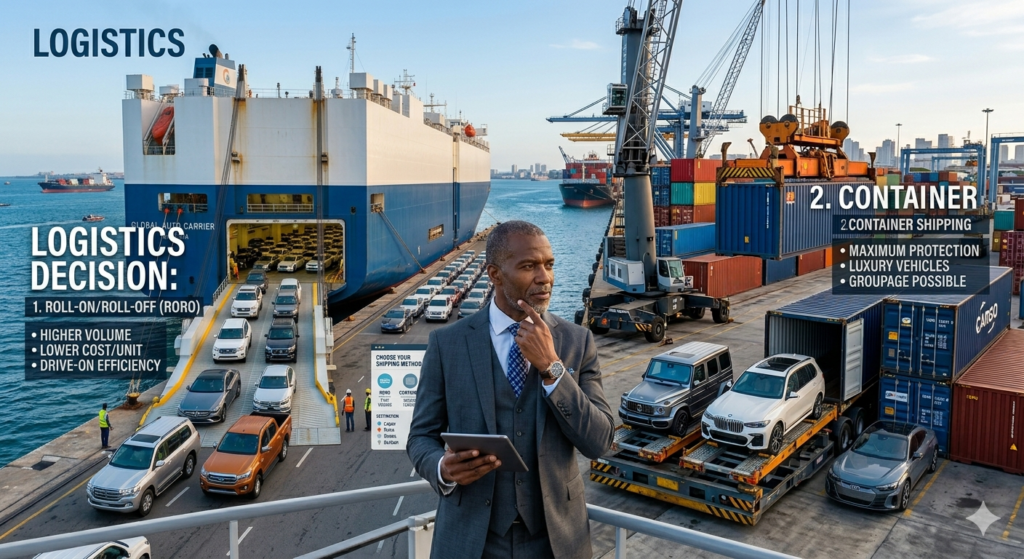
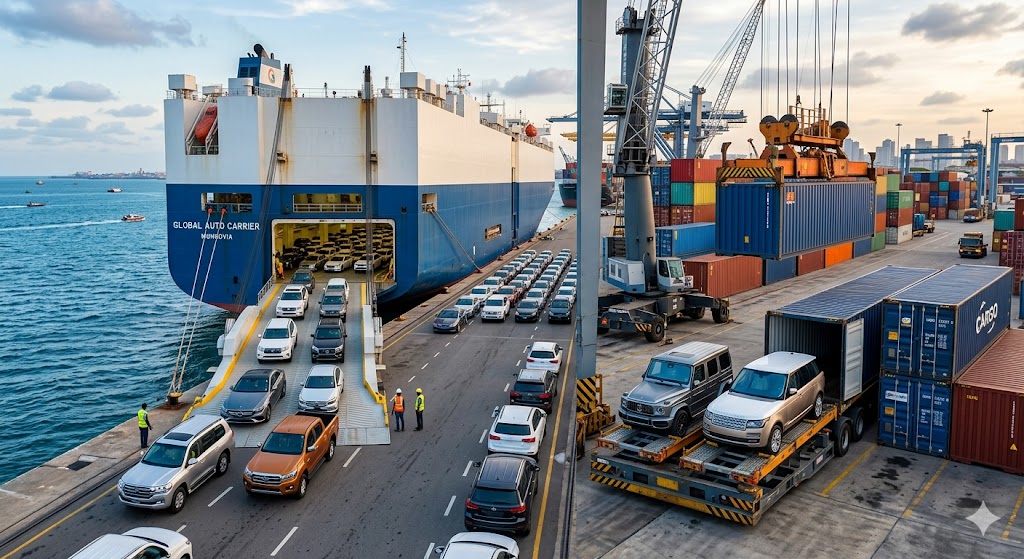
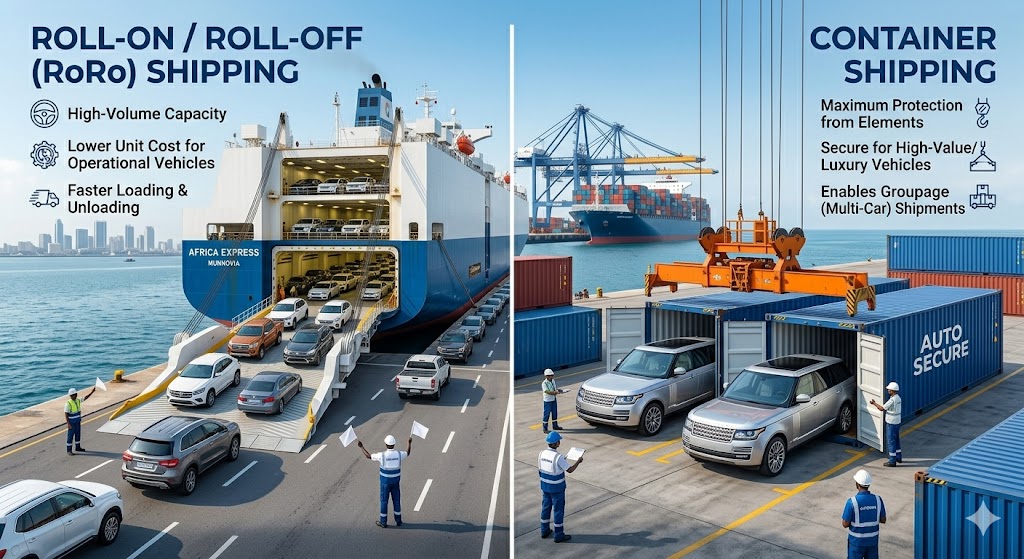
RoRo (Roll-on/Roll-off) shipping uses purpose-built vessels designed specifically for wheeled cargo. Your vehicle is driven onto the ship at the origin port, secured to the deck, and driven off again at the destination port. No lifting, no cranes, no containers.
These ships are the workhorses of the global automotive industry. Most new cars rolling out of factories in Japan, Germany, South Korea, and the USA reach their markets via RoRo vessels. The system is fast, operationally efficient, and relatively affordable — which is exactly why it has become the default method for bulk vehicle exports worldwide.
How the RoRo process works:
- Your car is delivered to the designated RoRo terminal at the origin port.
- A terminal operator drives it onto the vessel via a ramp and secures it to the deck with straps and wheel chocks.
- The ship sails to the destination port, sometimes making intermediate stops along the way.
- At arrival, the vehicle is driven off the ship and handed over to your clearing agent or logistics representative.
- Customs clearance is completed, duties and taxes are paid, and you collect your vehicle.
The whole process sounds straightforward — and for standard vehicles on well-served routes, it usually is. The challenges tend to arise when a port doesn’t support RoRo vessels, or when the vehicle itself is non-standard.
What Is Container Shipping?
Container shipping places your vehicle inside a standard steel shipping container — either a 20-foot or 40-foot unit — which is then loaded onto a general cargo vessel alongside thousands of other containers.
Your car may travel alone in its own container (known as sole-use or exclusive container shipping) or share space with other vehicles or personal effects (known as groupage or consolidation shipping). Groupage is popular among importers who want to reduce costs by splitting the container fee with other shipments heading to the same destination.
How the container shipping process works:
- Your car is delivered to a container freight station (CFS) or loading depot at the origin.
- It is driven into the container, positioned carefully, and secured with wheel chocks, lashing straps, and wooden blocks.
- The container is sealed and a unique container number is assigned — this is your reference for tracking the shipment.
- The container is loaded onto the vessel at the port of origin and transported to the destination.
- At the destination port, the container is offloaded and moved to a container yard.
- Customs clearance is completed, the container is unsealed, and your vehicle is released.
Container shipping is more involved on both ends, but it offers a level of protection and versatility that RoRo simply cannot match.
RoRo vs Container Shipping: Side-by-Side Comparison
| Factor | RoRo | Container |
|---|---|---|
| Cost | Lower | Higher (especially sole-use) |
| Security | Less — exposed on deck | High — sealed in steel box |
| Weather protection | None | Full |
| Risk of damage | Moderate (salt air, minor scratches) | Low |
| Transit time | Often faster on major routes | Slightly slower due to loading/unloading |
| Route availability | Limited to RoRo-capable ports | Broader global coverage |
| Personal effects in car | Not permitted | Allowed in some cases |
| Tracking | Limited | Container number trackable online |
| Best for | Standard cars, budget shipments | High-value, classic, or modified vehicles |
| Vehicle age restrictions | No special requirements | No special requirements |
Cost Breakdown: What Will You Actually Pay?
Cost is usually the first question importers ask, and it’s worth exploring in detail because the price gap between RoRo and container shipping is real — but not always as large as people assume once you factor in everything.
RoRo Costs
RoRo shipping rates are typically quoted per vehicle based on its dimensions — specifically the length, width, height, and sometimes weight. A standard saloon car or small SUV will attract a lower rate than a full-size pickup truck or large 4×4. Rates from the UK to Lagos, for example, can range considerably depending on the season, route, and the specific vessel.
Because RoRo vessels are purpose-built and loading is rapid (a car is driven on and parked — no crane, no container stuffing), the operational overhead is lower and that reflects in the pricing. RoRo is generally 20–40% cheaper than container shipping for a comparable single-vehicle shipment.
Container Shipping Costs
With container shipping, you’re paying for the container itself (or your share of it in a groupage arrangement), plus loading and lashing fees, origin terminal handling charges, ocean freight, destination terminal handling charges, and container demurrage if you’re slow to clear customs.
The costs add up — but if you’re shipping two or more vehicles, or combining a car with household goods, a 40-foot container becomes far more economical. The cost per unit drops significantly when you spread it across multiple items.
The groupage option is worth highlighting for cost-conscious importers. If you’re shipping a single vehicle and the timing is flexible, a groupage or consolidated container booking allows you to share a container with other cargo. You only pay for the space your vehicle occupies. On many routes into West and East Africa, this can bring container shipping costs much closer to RoRo pricing, while still giving you the protection benefits of a sealed container.
Security and Vehicle Protection: A Critical Difference
This is arguably the most important factor when choosing between the two methods — and it’s where container shipping pulls well ahead.
On a RoRo vessel, your car is parked on an open or semi-enclosed car deck for the duration of the voyage. It is exposed to salt-laden sea air continuously. Over a multi-week voyage, this can cause surface corrosion on exposed metal, brake caliper rust, and general weathering. Minor scratches from vehicle loading and unloading are also possible — the cars are managed by terminal staff who may be handling hundreds of vehicles a day.
Container shipping completely eliminates these risks. Your vehicle is sealed inside a steel box from the moment it’s loaded at origin until the container is opened at destination. There is no exposure to sea air, no UV damage, no salt spray. The car arrives in essentially the same condition it left in — making container shipping the clear choice for:
- Classic and vintage cars
- Luxury and high-value vehicles
- Cars with custom paintwork or modified bodywork
- Recently restored vehicles
- Low-mileage or near-new imports where cosmetic condition matters
One more security advantage worth noting: RoRo vessels do not permit any personal belongings to be left inside vehicles. The cars must be empty. Container shipping, particularly sole-use containers, sometimes allows limited personal effects to be shipped alongside the vehicle — though this is strictly governed by the destination country’s customs rules, and duties may apply on the personal items.
Transit Times: Which Is Faster?
On paper, RoRo is often faster — but the full picture is more nuanced.
RoRo vessels on major routes (UK to West Africa, for example) typically operate on fixed schedules with regular departures. Loading a car onto a RoRo vessel at origin is quick — often just a matter of driving it up the ramp. At destination, it’s driven off. The turnaround at each port is efficient.
Container shipping adds time at both ends: vehicles need to be physically loaded into a container, the container needs to be stuffed and sealed, and at destination there’s the process of finding the container in the yard and unstuffing it. These steps add a few days on each end.
However, in terms of the actual ocean voyage, the difference is minimal. Both methods use the same sea routes, and transit time from origin to destination depends far more on the specific routing and any intermediate port calls than on whether your car is in a container or on a RoRo deck.
For most African routes:
- UK / Europe to West Africa (Lagos, Tema, Abidjan): 2–4 weeks at sea
- USA (East Coast) to West Africa: 3–5 weeks at sea
- UK / Europe to East Africa (Mombasa, Dar es Salaam): 3–5 weeks at sea
- Japan / UAE to East Africa: 3–5 weeks at sea
Add customs clearance time at destination — typically 1–3 weeks depending on the country, port congestion, and how prepared your documentation is — and you have your total import timeline.
Which African Ports Support RoRo?
Not every African port can handle RoRo vessels, and this is a practical constraint that can make the choice for you. RoRo requires specialised ramp infrastructure and sufficient depth alongside. The main RoRo-capable ports serving African importers include:
West Africa
- Nigeria: Tin Can Island Port and Apapa Port (Lagos)
- Ghana: Tema Port
- Côte d’Ivoire: Abidjan Port
- Senegal: Dakar Port
- Togo: Lomé Port (a major regional hub)
- Cameroon: Douala Port
East and Southern Africa
- Kenya: Mombasa Port
- Tanzania: Dar es Salaam Port
- South Africa: Durban, Cape Town, Port Elizabeth
- Mozambique: Maputo Port
If your target destination is a landlocked country — such as Uganda, Zambia, Zimbabwe, or Mali — your vehicle will need to transit through a coastal port regardless of shipping method. In that case, logistics beyond the port (clearing, inland trucking, transit documentation) become equally important factors in your overall plan.
Insurance: Don’t Skip It Either Way
Marine cargo insurance is strongly recommended for both shipping methods — but it is especially important if you’re choosing RoRo for a higher-value vehicle. Standard carrier liability under RoRo terms is limited, and in the event of damage or total loss, you may recover far less than the vehicle’s actual value without your own comprehensive marine policy.
With container shipping, the risk of damage is lower, but insurance remains essential. Containers can be dropped, flood in extreme weather events, or arrive with moisture damage from condensation. A good marine cargo policy covers you against all of these eventualities.
When sourcing insurance, make sure the policy specifically covers the vehicle’s declared value and the destination country. Some standard marine policies exclude certain African ports or require endorsements for specific regions.
Key Documents Required for Both Methods
Regardless of whether you ship via RoRo or container, the customs and export documentation requirements are essentially the same. You will typically need:
- Original vehicle title or V5C logbook (proof of ownership)
- Bill of sale or purchase invoice (showing the agreed purchase price)
- Export certificate from the origin country’s customs authority
- Destination country import declaration
- Marine cargo insurance certificate
- Packing list (for container shipments with additional items)
- Photo identification of the importer or consignee
Import requirements vary significantly by country. Nigeria, Ghana, Kenya, and South Africa all have different age restrictions on vehicles, varying duty and tax structures, and different requirements for conformity or roadworthiness testing on arrival. Always verify the specific requirements for your destination before you book — not after.
Which Is Right for Your Car? A Practical Decision Guide
Choose RoRo if:
- You’re shipping a standard saloon, SUV, pickup truck, or motorcycle
- Cost is your primary concern and the vehicle is not particularly high-value
- Your destination port has reliable RoRo service
- The vehicle is in average condition and you’re not concerned about minor cosmetic exposure
- You don’t need to ship personal belongings alongside the car
- You need a quick booking on a well-served route
Choose container shipping if:
- You’re shipping a classic, luxury, or high-value vehicle
- The car has custom bodywork, specialist paint, or expensive modifications
- You want to consolidate household goods or spare parts with the shipment
- Your destination port doesn’t support RoRo
- You’re shipping to a less common destination where container routes are more flexible
- You want a fully trackable, documented shipment with end-to-end chain of custody
- Maximum protection and peace of mind are worth paying a premium for
For many importers, the right answer comes down to a simple question: how much is the car worth, and how much would it cost to fix cosmetic damage? If the repair bill from a few scratches or surface corrosion would comfortably exceed the price difference between the two methods, container shipping pays for itself.
Common Mistakes to Avoid
Booking based on price alone. A cheaper RoRo quote can become expensive if the vehicle arrives with corrosion or damage and you’ve underinsured it. Always factor in the full risk profile.
Ignoring destination port infrastructure. Confirm that your chosen port can receive the shipping method you’ve booked before the vehicle leaves origin. Redirecting a shipment mid-voyage is costly and complicated.
Leaving the paperwork to the last minute. Incomplete or incorrect documentation is one of the leading causes of delays and demurrage charges at African ports. Have everything prepared and verified before your vehicle is loaded.
Not budgeting for destination costs. Import duties, port handling fees, clearing agent fees, and inland transport from the port to your location can add significantly to the total cost. Factor these in from the start.
How Autoriva Can Help
At Autoriva, we specialise in vehicle imports across Africa. We work with vetted shipping partners offering both RoRo and container services on all major corridors — UK, USA, UAE, Japan, and Europe to West, East, and Southern Africa. Our team will assess your specific vehicle, destination, and budget and recommend the method that makes the most sense for your shipment.
We also handle the paperwork, customs liaison, and port clearance coordination — so you don’t have to navigate any of this alone.
👉 Get a Shipping Quote — autoriva.africa
Have questions about shipping your car to Nigeria, Ghana, Kenya, South Africa, or anywhere else on the continent? Reach out to our team directly or leave a comment below — we’re happy to walk you through your options.